
Two houses on the same Livermore street put in new windows the same month. Same contractor, same glass, similar square footage. One homeowner watched the summer PG&E bill drop by a noticeable chunk. The other barely saw a difference and started to wonder what she’d paid for.
Both got good windows. The gap wasn’t the product. It was everything around it: which windows they started with, which way the house faced, how hard the air conditioner was already working. New windows do lower energy bills. How much they lower them is where the honest conversation begins.
The honest answer: yes, but it’s a range
Windows matter more than most people assume. Heat moving in and out through the glass accounts for a quarter to a third of a home’s heating and cooling energy, according to the U.S. Department of Energy. In a Livermore summer, when the afternoon sun turns west-facing rooms into greenhouses, that’s a lot of energy walking straight through the walls of glass.
So the savings are real. But “real” isn’t the same as “the same for everyone.” A handful of specific factors decide whether your bill drops a little or a lot.
What actually moves the number
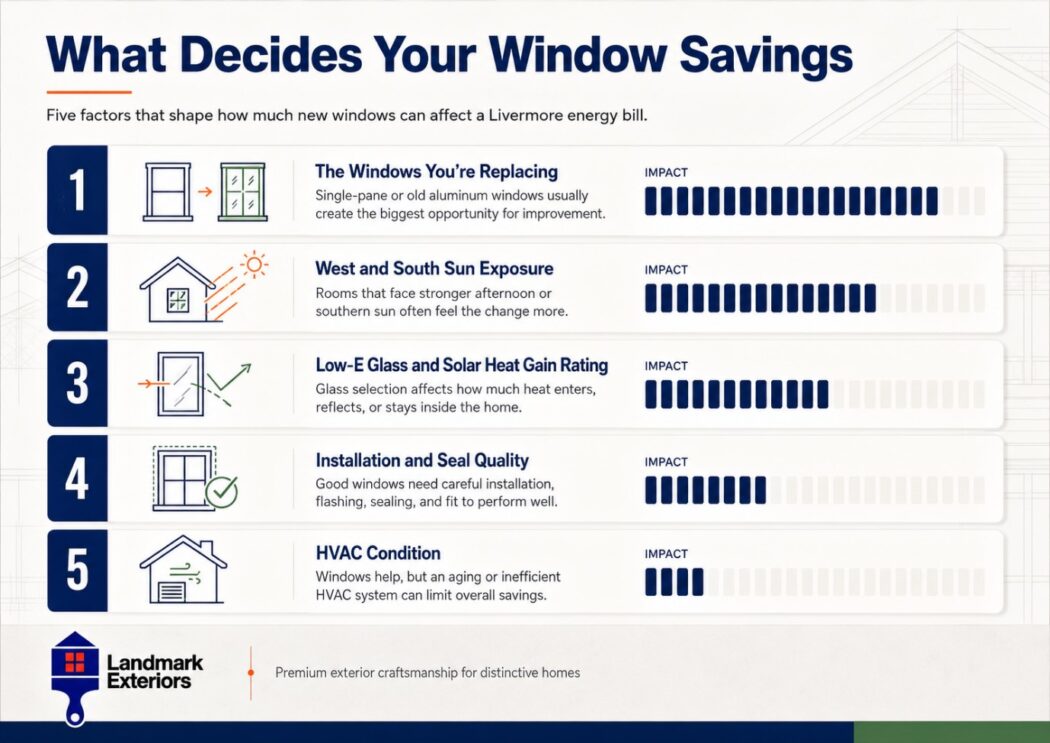
Start with what you’re replacing. This is the single biggest variable, and it’s the one nobody mentions in the ads.
Old single-pane windows and aluminum frames are the worst offenders. Aluminum conducts heat like a frying pan handle, and a single sheet of glass does almost nothing to slow the transfer. Swap those out and the drop can be dramatic, because you were bleeding energy from every opening. If you already have decent double-pane windows, the gain from upgrading is smaller. You’re improving a system that was already doing part of the job. Same new windows, very different before-and-after.
Then there’s which way your rooms face. West-facing rooms take the full force of the late-afternoon sun, exactly when Livermore is hottest and your AC is already straining. Those rooms drive your cooling load harder than any other part of the house. Windows that cut solar heat gain on the west and south sides do more for your bill than the same windows on a shaded north wall.
That’s where the glass spec earns its keep. Low-E glass windows carry a microscopically thin coating that reflects heat back outside while letting daylight through. A low solar heat gain rating on your sun-facing windows is the difference between a room that bakes at four o’clock and one that stays livable. This is the heart of any energy-efficient window replacement done for a hot inland climate rather than a coastal one.
Your HVAC system is the quiet partner in all of this. New windows lighten the load on your air conditioner, they don’t replace it. If your unit is old, oversized, or short on maintenance, it will keep running up the meter even behind perfect glass. Windows reduce the demand. What meets that demand still matters.
Last, and most overlooked: installation. A high-performance window set into a frame with air gaps and sloppy sealing leaks anyway. The best glass in the world can’t fix a bad fit. Tight, square, properly sealed installation is what turns the window’s rated performance into actual comfort. That’s the whole reason window replacement in Livermore should be handled by a crew that measures carefully and seals every unit right, not a rushed subcontractor.
Setting realistic expectations
Here’s what an honest installer will tell you before you sign anything.
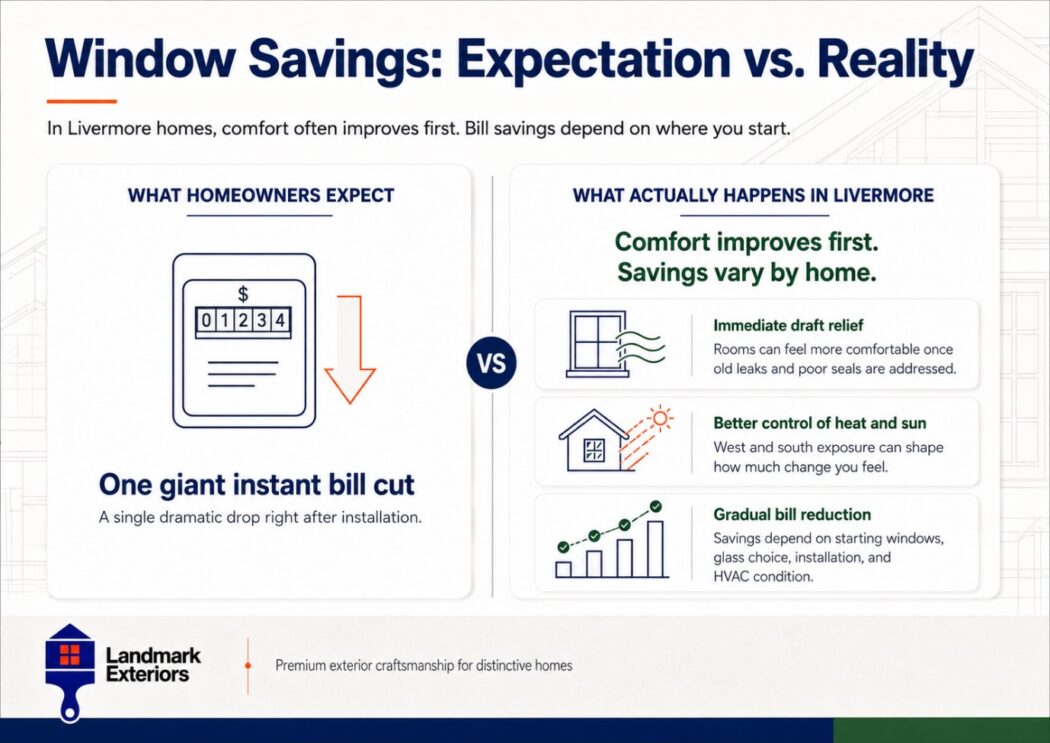
The comfort improvement is immediate and obvious. The drafts stop, the west rooms cool off, the afternoon glare softens. You feel it the first hot day. The dollar savings are also real, but they arrive gradually and scale to everything above. The Department of Energy estimates that replacing old windows trims roughly 7 to 15 percent off annual energy bills, and where you land in that range depends on your starting windows, your climate, and your sun exposure. A homeowner ripping out 1970s aluminum single-panes on a west-facing wall sits near the top of that range. Someone upgrading tired-but-functional double-panes sits nearer the bottom. Neither is being cheated. They just started in different places.
The bottom line
New windows lower energy bills. The amount depends on what you’re replacing, how your home meets the sun, the glass you choose, and whether it’s installed right. Anyone who promises one flat number is guessing.
At Landmark Exteriors, we’ve been sizing up Bay Area homes since 1992, and we’d rather tell you honestly what to expect than oversell a number. If you want a straight assessment of what new windows would actually do for your home, book a free in-home consultation. Beyond Livermore, we also handle window replacement in Pleasanton, window replacement in Dublin, and window replacement in Danville, matching the glass and the seal to how each home meets the sun. We treat your house like it’s ours.