
The smell shows up in the afternoon. Morning walk-through of the yard, nothing. Then the sun hits the same strip of turf your dog has claimed as a bathroom, and by three o’clock there’s a sharp, sour edge to the air near the fence. Nobody spilled anything. The grass looks spotless. So where is it coming from?
That question sits behind a worry a lot of dog owners have before they ever install synthetic turf. Does artificial grass smell with dogs? It can. But the reason has almost nothing to do with the grass, and everything to do with basic chemistry playing out a few inches below the blades.
What’s actually causing the smell
Fresh dog urine barely smells at all. What you’re reacting to is what happens to it afterward.
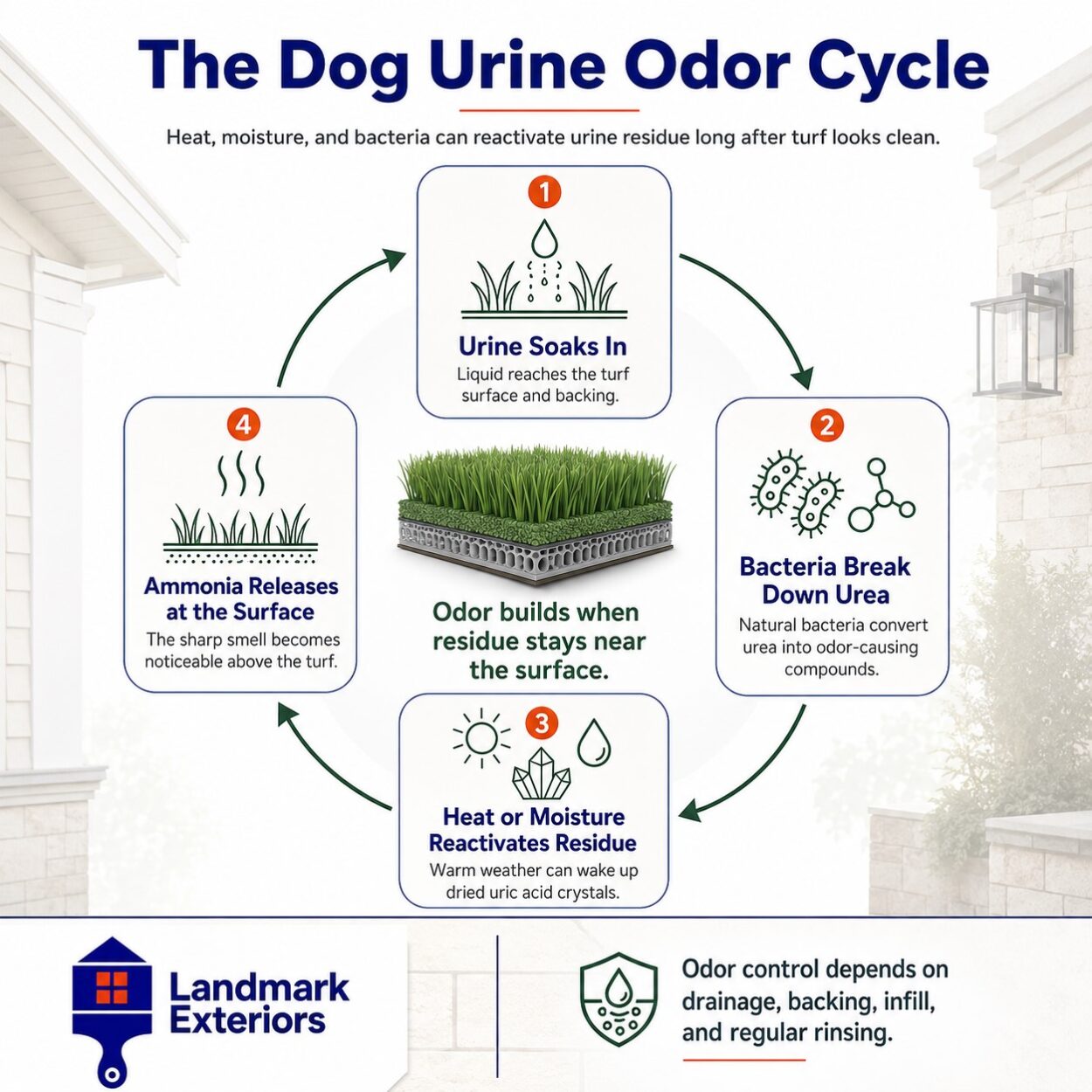
Urine carries a compound called urea. Once it lands and starts to dry, bacteria go to work breaking that urea down, and one of the byproducts is ammonia gas. That’s the pungent, catches-in-the-throat note you notice. The process isn’t instant. It builds over hours, which is why a spot can seem fine early and turn rank later.
Heat and moisture are the accelerants. Dried urine leaves behind uric acid crystals, and those crystals are stubborn. Rinse the surface, let it dry, and they sit there dormant. Then humidity rolls in or the afternoon sun warms the surface, the crystals reactivate, and the ammonia releases all over again. It’s the reason a yard can smell clean on a dry morning and pungent by mid-afternoon on a hot Livermore day.
None of this is a flaw in synthetic grass specifically. It happens on concrete, on natural lawns, in carpet. The difference is where the residue ends up, and whether it has anywhere to go.
Where standard artificial grass struggles
Here’s where the type of turf starts to matter.
A decorative lawn product is built to look green and handle light foot traffic. It was never designed around a dog using the same corner four times a day. The backing may drain slowly. The infill is often plain sand, which does the opposite of what you want: it holds liquid near the surface instead of letting it move through. Trapped moisture is exactly the condition bacteria need.
That’s the trade-off with regular artificial grass in a heavy pet area. It can work for light use. Push daily urine through it, though, and residue starts to concentrate faster than the system can clear it. The smell isn’t a mystery at that point. It’s a drainage problem wearing a chemistry disguise.
How K-9 Turf is engineered against it
Pet-specific turf attacks the odor at its source, which is the liquid sitting where it shouldn’t.
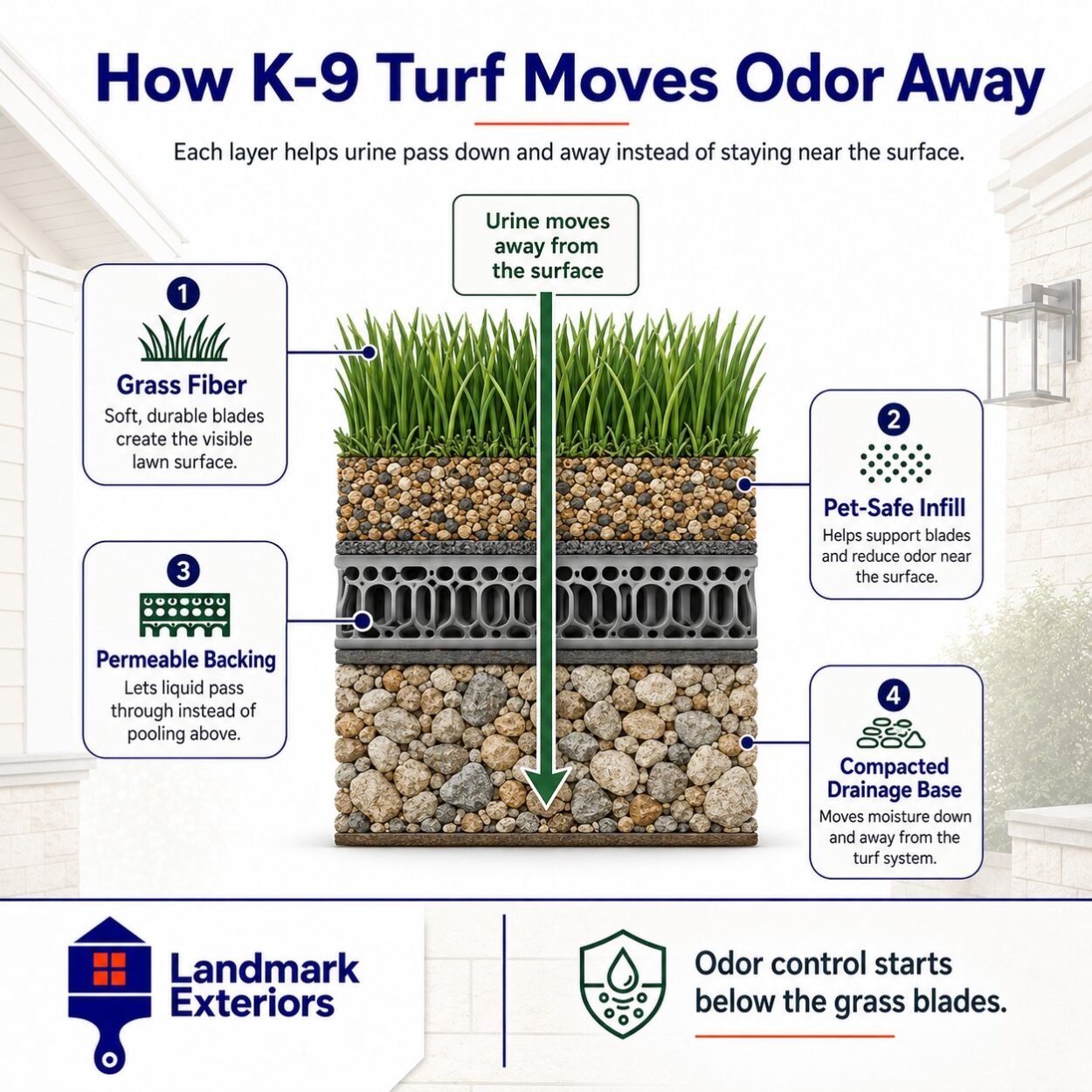
The whole system is built to move urine down and away from the surface fast. A permeable backing lets liquid drop straight through instead of pooling. Below that sits a compacted, graded base engineered so nothing settles into low pockets. The goal is simple: get the waste past the blades and into the drainage layer before bacteria have time to build ammonia near the surface where your nose lives.
Then there’s the infill, and this is where the real work happens. Pet-grade systems use materials like zeolite, a naturally porous mineral, in place of plain sand. Zeolite carries a negative charge, and its molecular structure lets it grab onto ammonium ions and hold them rather than releasing them as gas. That ion-exchange behavior has been confirmed in peer-reviewed research on how zeolite frameworks capture and swap ammonium ions. In a yard, that means the mineral is quietly intercepting the smell before it can lift off the surface.
Drainage, base grading, and the right infill working together is how professionally installed K-9 Turf can prevent artificial grass odor that a decorative lawn would trap. K-9 Turf in Livermore has to hold up to exactly this: active dogs, dry inland heat, and repeat-use potty zones.
What still needs upkeep
Engineering handles most of it. You handle the rest, and it isn’t much.
Pick up solid waste promptly, give favorite spots a rinse now and then, and a properly built pet turf system stays fresh without a fight. The one thing to remember is that low-maintenance doesn’t mean no-maintenance. Skip rinsing a heavily used corner for weeks and even good drainage can only do so much. For the full rhythm of what to do daily, weekly, and seasonally, the full maintenance schedule walks through it.
The bottom line for dog owners
So, does artificial grass smell with dogs? Only when the system underneath gives ammonia somewhere to hide. Build it right, and the smell has nowhere to settle.
At Landmark Exteriors, we’ve been treating Bay Area yards like our own since 1992, and we build pet turf around how your dog actually uses the space. If you want a cleaner, fresher yard without the afternoon whiff, book a free in-home consultation and we’ll design artificial grass installation across the Bay Area to fit your lawn, your dog, and your drainage. We treat your house like it’s ours.